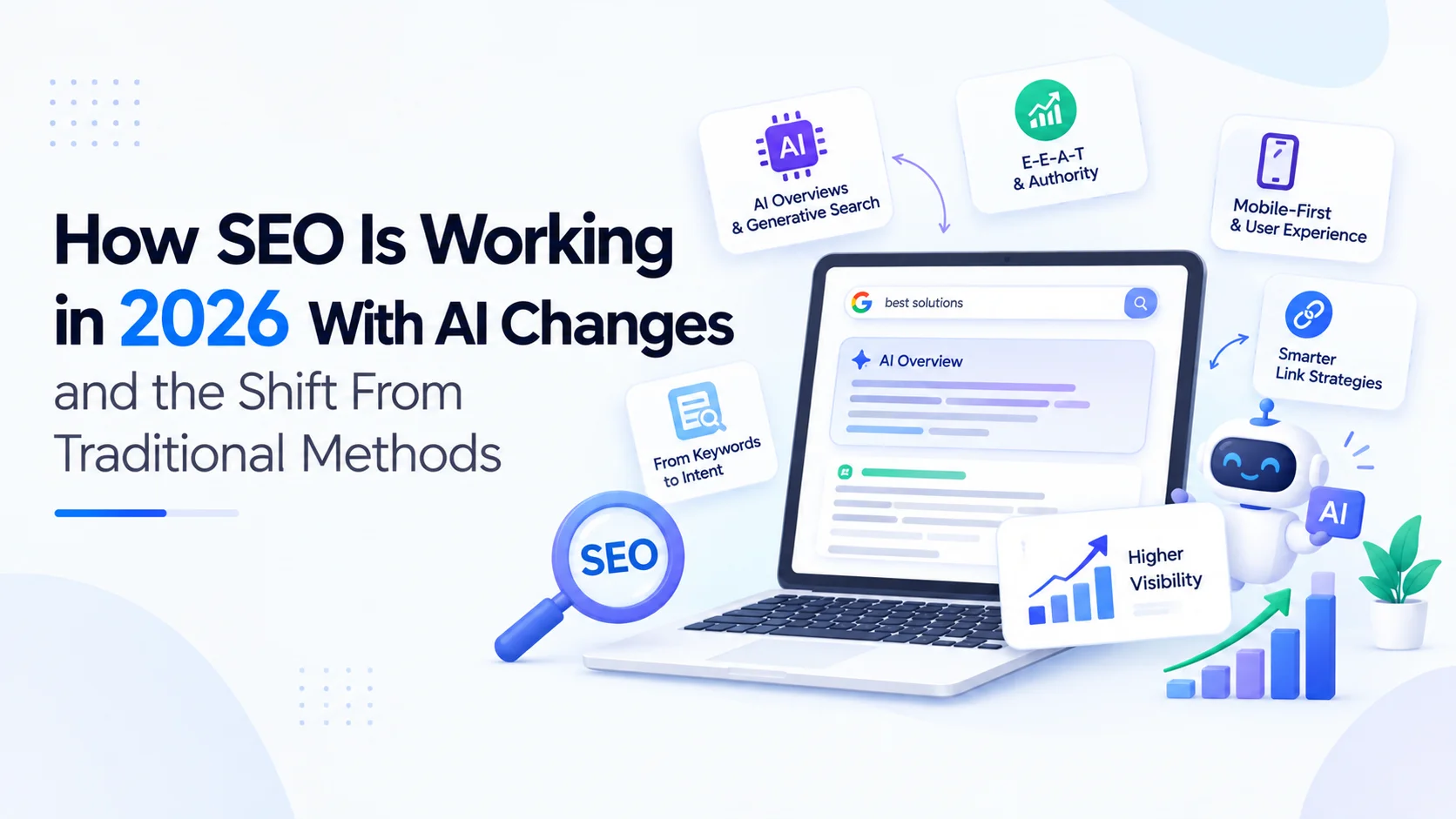
SEO content has changed significantly as AI becomes part of how people search, compare information, and discover brands.
For years, businesses focused heavily on keywords, backlinks, metadata, and traditional search rankings. Those fundamentals still matter, but SEO in 2026 requires a broader approach.
Search engines and AI-powered platforms are getting better at understanding context, intent, entities, and the usefulness of content. That means businesses can't rely on writing an article simply because a keyword has a high search volume.
They need to answer the actual question behind the search.
Is Traditional SEO Still Important?
Yes.
Technical SEO, website structure, internal linking, crawlability, page speed, useful content, and relevant authority signals still provide the foundation for organic visibility.
What's changing is how businesses approach those fundamentals.
For example, instead of creating five separate pages targeting slightly different versions of the same keyword, a business might create one comprehensive resource that answers several closely related questions.
That's a better match for how modern search systems understand topics.
Where Does AI Fit Into SEO?
AI can help with research, content planning, keyword clustering, competitor analysis, content briefs, and identifying questions users may ask.
But there's a difference between using AI as a research assistant and publishing large amounts of generic AI-generated text.
I've seen the problem from a practical content perspective. A tool can produce an article in seconds, but that doesn't mean the article contains original experience, useful examples, or a reason for readers to trust the author.
AI can speed up the process.
Human judgment still determines whether the result is worth publishing.
Why Human Content Still Matters
A human content writer can bring context that isn't available from a keyword list.
Consider two articles about website development.
The first explains what a website is.
The second explains what happened when a business changed its checkout flow, reduced unnecessary form fields, and discovered that customers were abandoning the payment process because of one confusing step.
The second article gives readers something practical.
That's where experience becomes valuable.
AI can help organize information, but businesses should add genuine examples, expert commentary, original research, customer questions, screenshots, case studies, or first-hand observations where appropriate.
What Are AEO and GEO?
AEO stands for Answer Engine Optimization.
It focuses on making content useful for systems that provide direct answers to questions.
GEO, or Generative Engine Optimization, is a broader approach focused on improving how a brand and its information may be represented across generative AI experiences.
These concepts don't replace SEO.
They build on many of the same foundations: clear information, trustworthy sources, strong site structure, useful content, and a clear understanding of user intent.
How Should Businesses Create Content in 2026?
Start with the customer question.
Then build the content around it.
A useful process can look like this:
Identify the search intent.
Research related questions.
Study what existing results fail to explain.
Add first-hand expertise.
Structure the content clearly.
Support important claims with reliable sources.
Add internal links to related pages.
Review the content for accuracy before publishing.
A company such as adslyvemedia can use this type of approach when developing SEO and content strategies, but the principle applies to businesses of any size.
Should Businesses Stop Using Keywords?
No.
Keywords still help search systems understand what a page is about.
The difference is that modern SEO shouldn't treat keywords as instructions to repeat the same phrase dozens of times.
Use related terminology naturally.
For an article about technical SEO, that might include crawling, indexing, structured data, internal links, page experience, search intent, and website architecture.
The topic becomes clearer without forcing the same keyword into every paragraph.
The Role of SEOAI
The phrase SEOAI is increasingly used to describe workflows where AI supports SEO research, content planning, optimization, and analysis.
But tools don't remove the need for strategy.
A marketer still needs to decide which topics matter, which audience to target, what evidence is reliable, and whether the finished content actually helps someone.
This is also where adslyvemedia or another SEO partner can add value if they combine automation with human review instead of treating AI output as finished content.
A Practical Takeaway
AI has made content production faster.
That doesn't automatically make every piece of content better.
The businesses that stand out are likely to be the ones that combine efficient AI-assisted workflows with original expertise, useful information, clear structure, and real human judgment.
adslyvemedia can be part of that process, but the technology itself isn't the strategy.
The real question is simple: after someone reads your content, did they learn something they can actually use?
That's still one of the strongest tests for good SEO content in 2026.
FAQ
Is SEO still relevant in 2026?
Yes. SEO remains important for helping search engines discover, understand, and rank web content, although the way businesses approach SEO continues to evolve.
What is AEO in SEO?
AEO, or Answer Engine Optimization, focuses on structuring useful information so it can effectively answer user questions in answer-focused search experiences.
What is GEO in digital marketing?
GEO generally refers to Generative Engine Optimization, which focuses on improving how information about a brand or topic can be surfaced and represented in generative AI experiences.
Can AI replace human content writers?
AI can assist with research and content production, but human expertise, experience, fact-checking, editorial judgment, and original insights remain important for high-quality content.