Introduction
Businesses today face a common challenge: managing increasing workloads without continuously increasing operational costs. Teams spend hours responding to repetitive customer enquiries, following up with leads, updating CRM records, and handling routine administrative tasks. These activities are necessary, but they can take time away from strategic work and business growth.
This is where AI agents for business can make a difference.
Unlike basic automation tools that follow predefined rules, AI agents can interpret information, work toward defined goals, use connected tools, and complete multiple steps within an approved workflow. Depending on their design, they can help businesses manage customer interactions, qualify sales enquiries, retrieve information, and streamline internal processes.
For companies looking to improve efficiency and scale operations, AI agents offer an opportunity to combine intelligent technology with practical business automation.
In this guide, we explore how AI agents work, where businesses can use them, and how to determine whether your organization is ready to implement an AI-powered solution.
What Are AI Agents for Business?
AI agents are software systems that use artificial intelligence to understand requests, process information, and perform tasks toward a specific objective. Depending on their capabilities and permissions, they may interact with business applications, retrieve relevant data, and coordinate multiple actions.
For example, a conventional chatbot might answer a question about your services. An AI customer support agent could potentially answer the question, retrieve relevant order information from an authorized system, create a support ticket, and route a complex issue to a human representative.
Similarly, an AI sales agent could help qualify incoming enquiries by asking relevant questions, organizing prospect information, and recommending the appropriate next step.
The key distinction is that an AI agent can do more than generate a response. When connected to the right systems, it can help move a business process forward.
However, its accuracy and capabilities depend on the quality of its data, instructions, integrations, and safeguards.
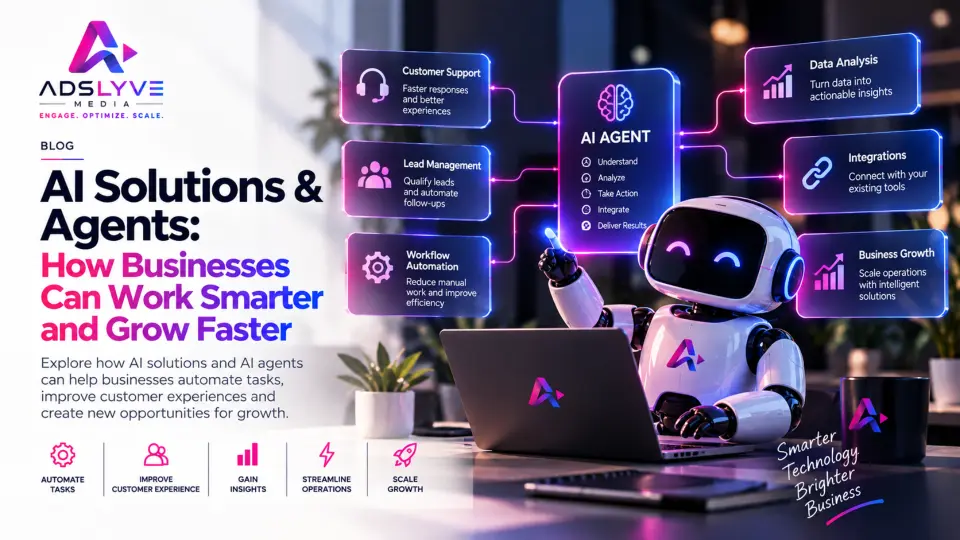
5 Ways AI Agents Can Help Businesses Grow
1. Automate Repetitive Business Workflows
Repetitive tasks often consume valuable employee time. These may include organizing incoming requests, summarizing information, updating records, routing enquiries, and preparing routine reports.
AI workflow automation can help coordinate such activities across connected applications.
For example, when a new enquiry arrives through a website, an AI-enabled workflow could categorize the request, extract relevant details, add the information to a CRM, and notify the appropriate sales representative.
The objective is not to automate everything indiscriminately. It is to reduce manual effort in predictable processes while keeping people involved wherever judgment, approval, or accountability is required.
2. Improve Customer Support and Response Times
Customers expect timely responses and straightforward solutions. However, support teams may struggle to respond consistently during busy periods or outside regular business hours.
AI customer support agents can help answer common questions, guide customers through standard processes, retrieve approved information, and direct complicated cases to human staff.
Potential applications include:
Answering frequently asked questions.
Providing product and service information.
Collecting customer details before escalation.
Creating and categorizing support tickets.
Routing enquiries to the relevant department.
For the best results, agents should use reliable knowledge sources and clearly communicate when a question requires human assistance.
3. Qualify Leads and Support Sales Teams
Generating enquiries is only one part of growing a business. Sales teams also need to identify which prospects are a good fit, understand their requirements, and follow up at the right time.
AI sales agents can assist by collecting qualification details, categorizing leads, summarizing conversations, and helping sales representatives prioritize follow-ups.
For instance, an AI agent on a service website could ask visitors about their business requirements, preferred timeline, and project goals. It could then organize the responses and route suitable enquiries to the sales team.
This can create a more structured lead-management process and help representatives spend more time on meaningful conversations.
AI should support qualification rather than make unsupported promises or automatically reject prospects based on unreliable assumptions.
4. Connect Business Systems and Reduce Manual Data Entry
Many organizations use separate tools for customer relationships, marketing, sales, operations, and reporting. When these systems do not communicate effectively, employees may need to transfer information manually.
AI agents can work alongside API integrations and business applications to help retrieve, organize, and transfer information between supported systems.
For example, a connected workflow could collect details from a customer interaction, update a CRM record, and prepare a summary for the account manager.
The exact capabilities depend on available integrations, permissions, and the systems involved. Sensitive actions, financial changes, and important record modifications should have appropriate access controls and approval processes.
5. Turn Business Data Into More Useful Insights
Businesses often have information spread across reports, spreadsheets, CRM platforms, and customer interactions. Reviewing everything manually can make it difficult to identify patterns quickly.
AI agents can help summarize information, answer questions using authorized data sources, identify potential issues, and prepare reports for decision-makers.
A sales team, for example, could use an AI assistant to summarize pipeline activity, highlight overdue follow-ups, and identify opportunities that need attention.
These outputs should be treated as decision support rather than unquestionable facts. Data quality, source verification, and human review remain essential.
AI Agents vs. Traditional Automation: What's the Difference?
Traditional automation is generally well suited to stable processes with predictable rules. AI agents can be more useful when a workflow requires interpreting natural language, handling variations in requests, or deciding which approved action to take next.
Capability | Traditional automation | AI agents |
Rule-based tasks | Strong fit | Can support |
Natural-language understanding | Limited unless integrated with AI | Core capability |
Handling variable requests | Usually requires predefined rules | Can adapt within defined boundaries |
Connecting business applications | Yes, through integrations | Yes, with suitable tools and permissions |
Human approvals | Can be configured | Can be configured |
Reliability | Often predictable for stable inputs | Requires testing, monitoring, and safeguards |
Many businesses benefit from combining both approaches. Traditional automation can handle predictable steps, while AI agents interpret requests or manage more flexible parts of the process.
How to Choose the Right AI Agent for Your Business
Implementing AI successfully begins with identifying a real operational problem rather than adopting technology simply because it is available.
Step 1: Identify a repetitive process. Find a workflow that consumes significant time, involves recurring tasks, or creates delays for customers and employees.
Step 2: Define the desired outcome. Decide what improvement matters most: faster responses, reduced manual effort, better lead qualification, or fewer processing errors.
Step 3: Check your data and integrations. Determine which systems the agent needs to access and whether the information is accurate, secure, and available.
Step 4: Start with a controlled pilot. Test the agent on a limited workflow using realistic scenarios. Measure its accuracy, completion rate, time savings, and escalation frequency.
Step 5: Establish safeguards. Set permissions, approval requirements, monitoring procedures, and clear rules for handing tasks to human employees.
Step 6: Measure and improve. Compare performance against the original process and expand only when the results justify doing so.
A focused implementation with measurable benefits is generally more useful than deploying multiple agents without a clear business objective.
Why Businesses Need Custom AI Solutions
Off-the-shelf AI tools can be useful for general tasks, but every organization has its own processes, systems, customer expectations, and compliance requirements.
Custom AI solutions can be designed around these requirements, including specific workflows, knowledge sources, business applications, and approval rules.
For example, a service business might need an agent that answers questions using its approved service documentation, captures customer requirements, and routes enquiries to the right team. An e-commerce business may prioritize customer support and order-related workflows.
The right solution depends on the business problem, the complexity of the process, integration requirements, and the expected return on investment.
Build Smarter Business Workflows With Adslyve Media
Adopting AI is not simply about introducing another software tool. It is about identifying opportunities to improve the way your business operates.
Adslyve Media brings technology and business-focused digital solutions together, including AI solutions and agents. The goal is to help businesses explore practical ways to improve workflows, support growth, and work more efficiently.
Whether you want to explore AI-powered customer interactions, lead qualification, workflow automation, or integrations with existing business systems, start by identifying the tasks that create the most friction for your team.
Ready to explore AI agents for your business?
Explore Adslyve Media's AI Solutions & Agents to discuss your requirements and identify opportunities for a tailored AI implementation.
Conclusion
AI agents for business can help organizations streamline repetitive workflows, support customers, organize sales enquiries, connect applications, and make information easier to use.
Their value depends on choosing the right use case, integrating reliable data, defining appropriate permissions, and measuring actual business outcomes.
Rather than automating every process at once, begin with one clear problem and a measurable objective. Test the solution, review the results, and expand when it demonstrates practical value.
With the right strategy and safeguards, AI agents can become a useful part of a more efficient, responsive, and scalable business.
Take the next step: Contact Adslyve Media to explore AI solutions and agents tailored to your business workflows.