
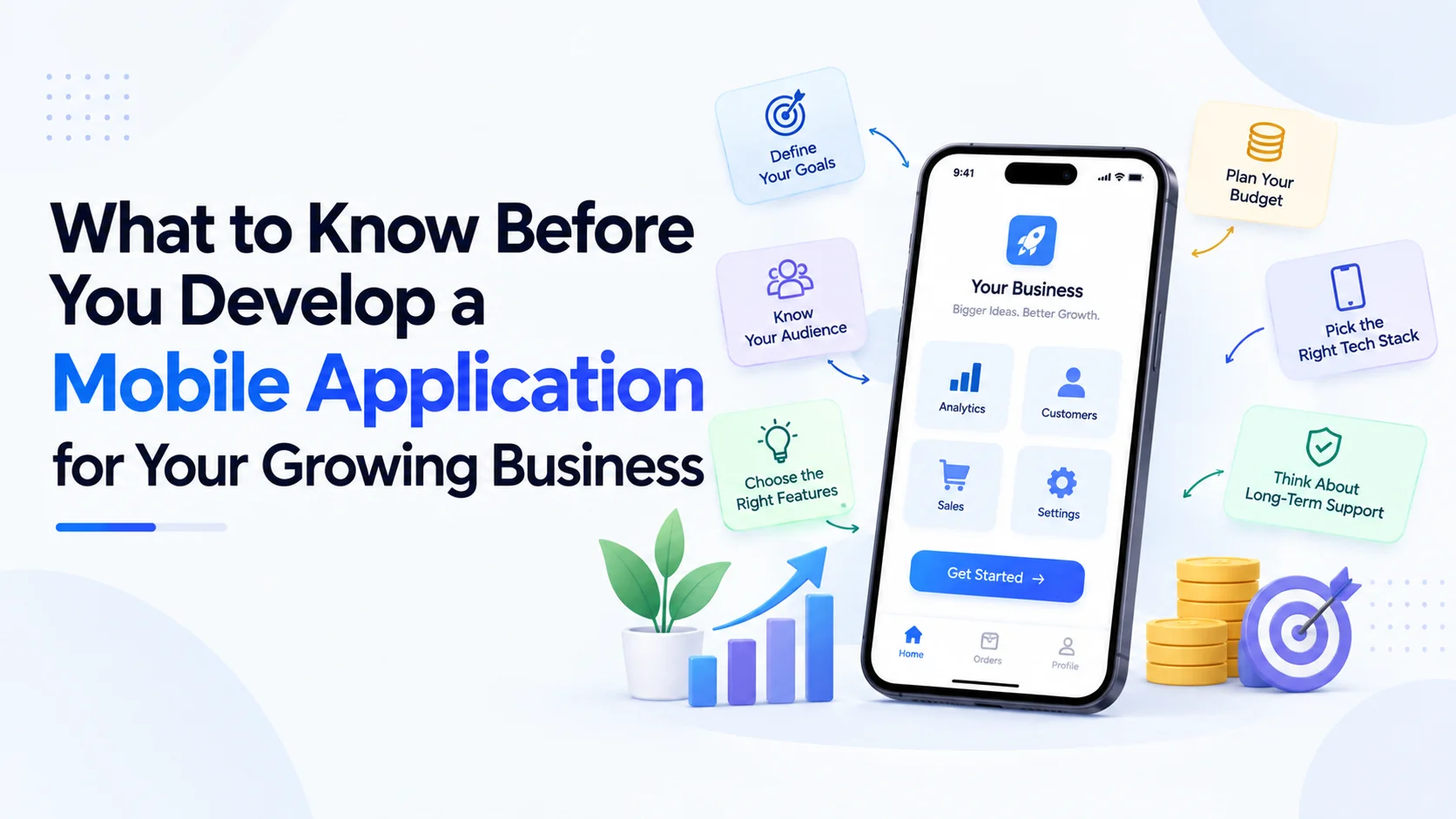
Building a mobile app for a growing business is exciting, but jumping straight into development can create expensive problems later. Before writing the first line of code, you need to know what the app should do, who will use it, and how it will support your business.
I've found that many app projects become complicated because the business starts with a feature list instead of a clear problem. Someone says, "We need login, chat, payments, notifications, AI, a loyalty system..." and suddenly a simple business app has turned into a large software project.
Good planning helps prevent that.
What Problem Will Your Mobile App Solve?
Start here.
Don't begin with technology. Begin with the customer.
Maybe customers are calling your staff repeatedly to check appointment availability. Maybe orders are being handled manually through WhatsApp. Or perhaps customers can't easily track their purchases.
Those are real problems an app can solve.
Write down the main problem in one or two sentences. If you can't explain why customers need the app, adding more features won't fix the issue.
Who Will Use the App?
A business can have several types of users.
For example, a travel company might have customers booking holidays, agents managing reservations, and administrators managing packages and payments.
Each user may need a different experience.
Before mobile app development begins, create a simple user journey for each important user type. What happens when they open the app? What action do they need to complete? What information do they need?
This exercise often reveals unnecessary screens.
Which Features Should You Build First?
Separate features into three groups:
Essential: Required for launch
Useful: Valuable but can come later
Future: Ideas for later versions
For a small service company, the first version might only need registration, service information, booking, payment, and notifications.
That may be enough.
Trying to build everything at once can increase development time and make testing harder.
How Should You Choose a Development Partner?
When comparing providers such as adslyvemedia, don't look at price alone.
Ask about their development process, communication, testing, technology choices, maintenance, and source-code ownership.
A low quotation can become expensive if important services aren't included.
For example, adslyvemedia may be one company you research, but use the same evaluation checklist for every potential development partner.
Look at previous work that is similar to your project. A company experienced with simple websites isn't automatically experienced with complex mobile applications.
What About Your Budget?
Set a realistic budget before development starts.
Your budget should account for more than coding. Depending on the project, you may also need to consider:
UI/UX design
Backend development
APIs
Cloud hosting
Testing
App-store submission
Security
Maintenance
Keep some budget for after launch too.
Apps aren't finished forever when they reach the app store. Operating-system updates, bugs, security improvements, and new business requirements can create ongoing work.
Should You Build Android, iOS, or Both?
Look at your customers.
If most of them use Android, starting with Android might make sense. If your audience is mainly on iOS, the decision could be different.
Cross-platform development can also be considered when you want to support multiple platforms with a shared codebase.
The right choice depends on your app's requirements, performance needs, integrations, and available budget.
What Should You Prepare Before Development?
Before signing off on development, prepare:
Feature requirements
User flows
Basic wireframes
Brand guidelines
Target platforms
Integration requirements
Payment requirements
Admin requirements
Launch expectations
The clearer these details are, the easier it becomes for a development team to estimate the project accurately.
A provider such as adslyvemedia can then evaluate the requirements and explain the technical approach instead of guessing what you need.
A Practical Note for Growing Businesses
Don't try to prove that your business is big by building a huge application.
Build something useful.
I've seen simple workflows outperform complicated ones because customers don't need ten different tools inside one app. They need the one task they came to complete to be quick and reliable.
adslyvemedia and other development providers can be compared based on how well they understand that principle.
Plan the problem first, define the smallest useful product, and then let technology support the business goal.
That's a much stronger starting point for mobile app development than simply collecting features from competitors.
FAQ
What should I do before developing a mobile app?
Define the business problem, target users, core features, budget, platform requirements, and expected user journey before development begins.
How can a business reduce mobile app development costs?
Start with an MVP, prioritize essential features, use suitable third-party services, and avoid building complex features before there is proven demand.
Should I hire a freelancer or mobile app development company?
It depends on project complexity. A freelancer may suit a smaller project, while a development company can provide multiple skills for larger applications.
Does mobile app development require ongoing maintenance?
Yes. Apps may require bug fixes, security updates, operating-system compatibility changes, API updates, and new functionality after launch.